

Can an ordinary phone camera read the shape of your pulse from a color-changing skin patch?
Blood pressure is usually checked with a cuff that squeezes the arm and gives a single number. But the pulse itself carries more information: its shape changes as it travels through arteries, and those changes can hint at how blood moves in the body. A new passive wrist patch tries to turn that hidden detail into something an ordinary phone camera can see. The device has no battery or wires. It uses a stretch-sensitive film whose color shifts when the artery beneath it beats.
Quick takeaways
A stretch-sensitive film turns arterial motion into color changes
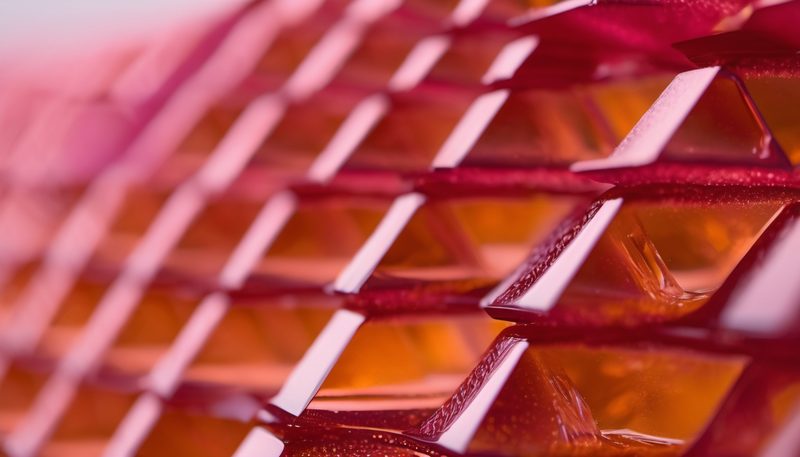
The patch is one soft silicone piece with no battery, wires, or electronics on the skin. One side carries fine parallel ridges that split white light into colors, like the rainbow on a compact disc. When it rests over an artery, each pulse stretches those ridges by a tiny amount. That shift in spacing changes which colors bounce back, and a standard phone camera records the change as a moving color pattern.
In bench tests, a machine stretched that film while a phone camera filmed it. The movement was about 2 percent peak to peak, close to the scale of an arterial pulse. It produced roughly a 9 percent change in red, green, and blue brightness over at least 1000 cycles. The color signal did not visibly fade or drift during that run, and it stayed well above the phone camera’s own noise.
The same film was made with two ridge spacings because different spacing changes how strongly the colors respond. A wider spacing suited larger areas, while a tighter one let smaller prototypes be tuned for a chosen range of stretch or viewing angle. On its other side, tiny inverted pillars form a bio-inspired adhesive surface that grips skin like small suction cups. That grip helps the patch stay still over a moving artery, so the color pattern can keep following the pulse instead of sliding out of place.
Thirteen volunteers and two mid-range phones under ordinary ceiling light
A proof-of-concept test put the patch over the radial artery in the wrist of thirteen healthy volunteers who sat or lay still under ordinary ceiling light. To read it, two unmodified mid-range phones recorded video with their default camera apps, while a finger-pressure sensor on the middle finger of the same arm produced a continuous reference trace. That comparison focused on shape and timing rather than raw voltage, because the patch reads color changes while the finger device measures pressure.
From those recordings, the patch produced a pulse for every volunteer, although waveform quality varied because skin adhesion was uneven. Those averaged traces followed the reference pressure waveforms in overall shape, and two volunteers showed benign irregular heartbeat events that appeared in both signals. But the phones that made those traces captured about 60 frames each second, so their native timing step stayed fixed at one frame interval. That limit matters for sub-beat timing, because faster cameras could later capture sharper transient features and subtle arrhythmias.
Where the patch signal stayed clear and where it blurred
The clearest win was shape rather than a simple beat count. That shape held across every volunteer, and the averaged traces followed the finger-pressure reference closely enough to keep the same broad outline. The match weakened where the patch did not sit evenly on skin, so waveform quality varied from person to person.
Where that quality stayed high, five detailed cases showed a reflected wave, a small secondary bump caused by pressure waves bouncing back from peripheral arteries. That bump became clearer when the second derivative was calculated, because it highlights changes in slope. This detail matters beyond heart rate, since it can support analysis of how the pulse changes as it travels through smaller vessels.
But the blur appeared where fine timing mattered most, and in one person’s reflected wave. That bump appeared in both signals for 12 of the 13 participants, and their intervals from main pressure rise to reflection overlapped substantially. In the remaining participant, the reference had the bump but the patch did not show it reliably. The camera limit set that boundary: at about 60 frames per second, each frame lasted roughly 16.7 ms, so sub-beat timing could not be read more finely than what the video actually captured.
A quiet path toward everyday monitoring
In the resting human test, a pulse could be read from colour alone, without electronics on the skin and without any special camera. That result points to a simpler route for wearable pulse monitoring, because an ordinary phone can record arterial motion through light that bends off a nanoscale pattern in the film.
The check was done at rest rather than imagined for sleep or clinics. Thirteen healthy volunteers wore the patch over the radial artery on their non-dominant wrist while a smartphone filmed it with its default camera app. The rooms had ordinary ceiling light, and two mid-range phones were used. A finger volume clamp measured continuous noninvasive pressure in the same arm and supplied a reference pulse at the same time. In that test, the patch captured the main beat in all thirteen people, and a timing interval from the systolic peak to a reflected component could be identified for twelve of them. In the detailed examples, that reflected feature was clearest after taking a second derivative of the patch signal. The recordings also revealed two benign irregular heartbeat events that appeared in both signals. One was a premature beat, and the other was an extended pause between beats.
Adhesion changed from person to person, and one participant’s patch signal did not show the reflected component clearly. The phone recorded at 60 frames per second, which set a limit on how finely timing could be judged, so faster video would sharpen the picture. The human test involved thirteen healthy volunteers at rest, which is encouraging but far too small for clinical confidence. The two-sided film can be made from reusable molds outside a clean room once those molds exist.
If a pulse can be read from colour alone, the next device may need no battery at all. That is the quiet promise here: a passive patch, an ordinary phone camera, and a signal that comes from stretch rather than electronics.
You may also like

Health and medicine · Technology and computing
Can the scan used to aim radiotherapy become accurate enough for dose planning? A physics-aware model may do it without another CT scan
Health and medicine · Genetics and biotechnology
Can a dissolving skin patch make melanoma cells easier for chemotherapy to kill?

Space and astronomy
What do calcium and tin isotopes reveal about the invisible matter inside neutron stars?

Technology and computing